
Loom: New Enterprise Messaging Tool? (link)
- Think Slack x Telegram (video messaging capabilities), but on email
- Pros: efficient, candid, and people always like to see themselves so are incentivized to continue using this product. It’s also easier to dictate / record instructions in an email than type it out concisely. Uploading speed is also fast, as it uploads while the user records
- Cons: Could be overwhelming to have yet another messaging platform. Also, super expensive. Pro is $10 / month / user (equivalent to G-Suite pricing)
- Competitors: GoVideo, Soapbox. But Loom is market leader with clients wins at large firms (Uber, Airbnb, Hubspot, etc.)
Briq: Rethinking construction (link)
- Using blockchain-based ledger and machine learning tools to provide strategic insights into building and project developments
- Predict things like success of individual projects, where demand for new projects is likely to occur and how to connect data around construction processes
- ProjectIQ – monitors and manages individual projects and workflows
- MarketIQ – market intelligence around where potential projects are likely to occur / which projects will be the most successful
- Proven management team (Bassem Hamdy, former Wall Street, and helped build Procore)
- Great thesis – using data to determine analytics around construction and development, with 12 major developers already added to the client base
Growth of Microbrands threatens incumbents (link)
- The growth of “just-in-time” manufacturing means startups no longer need to splurge on inventory
- Selling directly to consumers means that microbrands boast a wealth of data as opposed to data filtered by retailers
- Online advertising, using platforms such as Facebook, allows brands to target customers with great accuracy. The vast majority of growth in advertising is coming from the digital kind, and a large proportion of this is from small advertisers
- In the long term some small brands will be swallowed up but others will be encouraged
Zoom: Thinking about an IPO in April (link)
- Web-ex but better code, started by Web-ex engineers who was frustrated the company’s code was unchanged after it was sold to Cisco for $3.2bn in 2007
- CEO, Eric Yuan, was the WebEx’s 10th employee, and when he founded Zoom, brought 45 additional WebEx employees
- $1bn post-money valuation after $100mm from Sequoia in 2017
Daimler and BMW invest $1.1bn in urban mobility services (link)
- In March 2018, decided to merge their urban mobility services into single holding company with 50% stake in each, now want to reshuffle their collective 14 services into 5 JVs (Reach Now (ride rental), Charge Now (charging stations), Park Now (parking services), Free Now (ride hailing), and Share Now (free-floating services)
- Currently 60mm users total
- Vision is to merge these services closely to form a single mobility service portfolio with an all-electric, self-driving fleet of vehicles that charge and park autonomously
Millennials like pretty / novel credit cards, and Venmo knows (link)
- Limited edition rainbow card offered to top Venmo cardholders on Friday, then available to all users starting March 4th
- Unique card styles have proven attractive for millennial customers: Chase Sapphire Reserve was novel because of the metallic alloy composition (company ran out of alloy for time because of high demand)
- Venmo card saw 300% MoM growth in monthly active card users from August – September 2018, with largest spend in supermarkets and restaurants
Lyft @ $20/$25bn?? (link) vs Uber valuations
- Lyft’s revenue grew from $412mm in H1 2017 to $909mm in H1 2018 (120%)
- Net Loss H1 2017 $255mm to $373mm in H1 2018
- Assuming Lyft grows H2 2018 at 30% ($2.1bn revenue), $20bn valuation implies 10x revenue; $25bn valuation implies 12x revenue
- See sensitivity analysis: (poorly formatted because I’m remote-ing into my office computer on a Mac to use excel lol)

- Now, in comparison to Uber
- GAAP Revenue in 2018 is $11.3bn, net loss $1.8bn
- Current valuation of $120bn, worth around 10.6x 2018 revenue
- See sensitivity analysis:
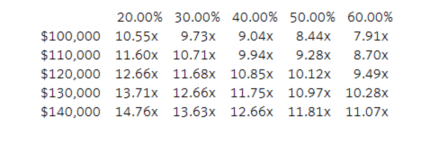
- Note that the trading at pretty comparable multiples though the growth profiles differ (Lyft’s growth, given its smaller scale, is higher). Also, Uber’s growth story is international expansion + food services, while Lyft seems to corner itself in the ride-hailing services with an emphasis on affordable rides (link)
Apple isn’t doing too hot in China – offering interest-free financing (link)
- Deals are coming in post Apple’s revenue guidance cut from $89-$93bn to $84bn due to economic deceleration (esp in China)
- Sales dropped 40% in India in 2018
- Affordability is an issue when comparable phones cost significantly less (Xiaomi or OnePlus)
- Chinese citizens probably have more purchasing power, so starting this financing plan (affordability initiative), if proven effective, could move to India
- Smartphones globally aren’t doing great either, global smartphone growth up 1.4% due to high-end buyers not upgrading for marginal upgrades
- Huawei achieved the top growth of the five global smartphone vendors
- Mid-tier Honor series helped company exploit growth opportunities, especially in emerging markets
- Future smartphone growth overall seem dependent on two things 1) pure innovation 2) price point / affordability. Apple especially lies at the crux where pure innovation is stalled (good is good enough), and the product isn’t marketable to the growing emerging markets
- Interested to see how Samsung’s foldable phone fares in the market with its steep price tag (perhaps limiting mass adoption?)
Another D2C company! Typology (link)
- Challenging FMCG (fast-moving consumer goods) with pure digital player. FMCG includes cosmetics, food, DIY, etc.
- Of course, wouldn’t be a pure internet / aesthetic player without the vegan, cruelty-free, made in France labeling
- Differentiator: Wants to scale beyond single brand (Glossier, etc.) and create e-commerce giant with multiple sub-brands, hundreds of products, and an aggressive e-commerce strategy
- Questions:
- Isn’t the upside to these small, niche, D2C players the ability to focus distribution / R&D / manufacturing on a limited amount of products? (link)
- Dilutes immediate brand awareness without (almost confusing) product lines, especially with no brick and mortar presence
- Can see this working as a marketplace for niche players (platform play), and less so a pure D2C (full value chain) player
- Questions:
 Nat's Corner